The Method
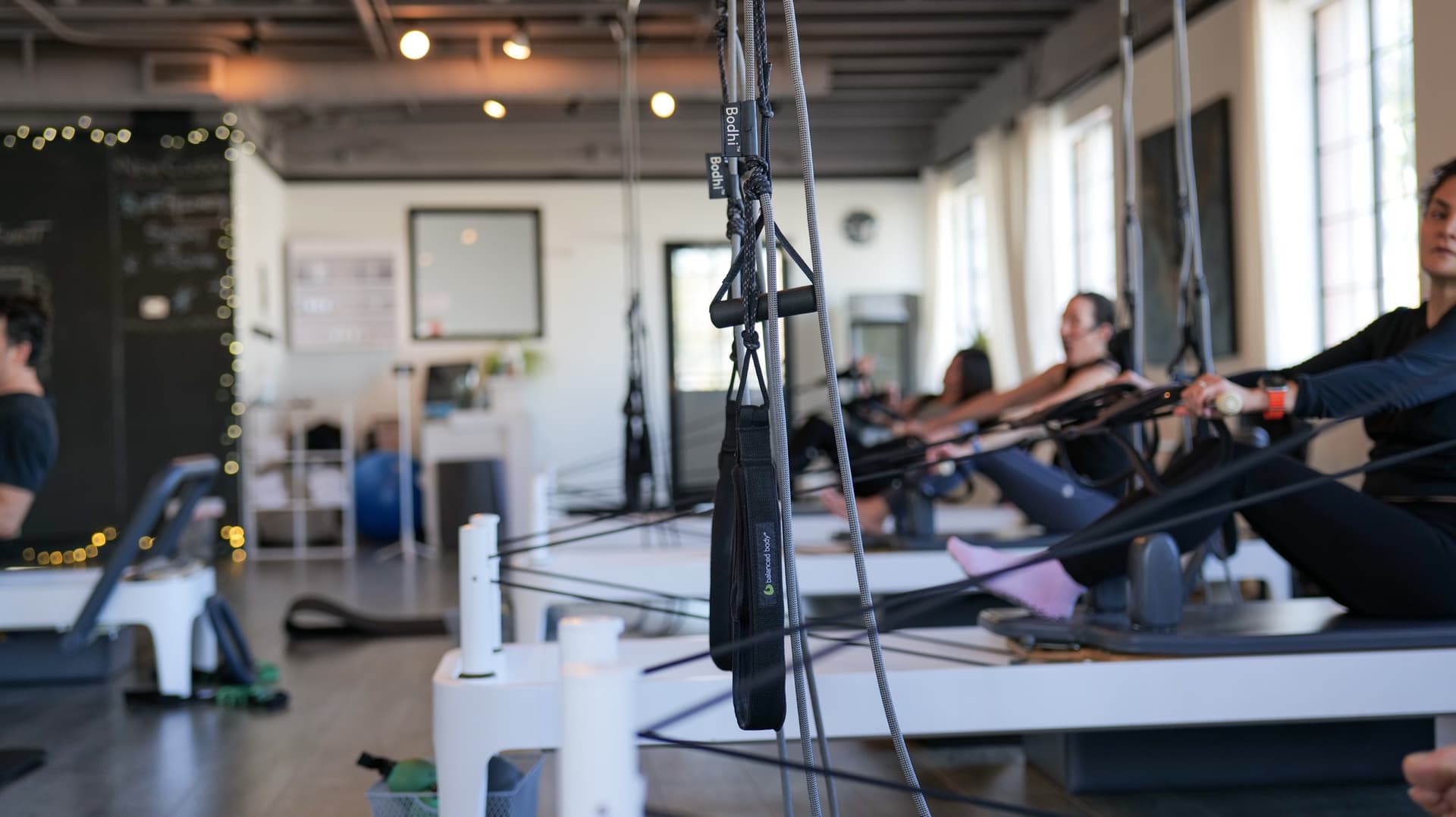
Bodhi Suspension Ropes
Suspension training designed with a Pilates brain, and the reason our members' balance keeps surprising them.
The Basics
What It Is
The Bodhi Suspension System is a rope-based suspension trainer made by Balanced Body, the same company that builds our Allegro 2 Reformers. Two ropes anchor overhead, and each rope carries two adjustable loops, which gives you four independent points of contact instead of a single strap.
You train against your own body weight. Stand, kneel, plank, or hang; put a hand or a foot in a loop; and the angle of your body becomes the resistance dial. Walk your feet forward and an exercise gets gentler. Walk them back and the same exercise humbles you.
Because the ropes move freely, nothing is stabilized for you. Every press, pull, and lunge doubles as balance work, which is exactly the kind of strength that follows you out of the studio: onto a paddleboard, up a trail, through a golf swing, into your seventies.
The Difference
Not a TRX
If you have used a TRX, you know the idea of suspension training. The difference is in the architecture. A TRX is a single strap from a single anchor, so both hands (or both feet) share one line, and most of the work lives in a plank-shaped world. Bodhi's two ropes and four contact points work independently: each arm and each leg can be loaded on its own line.
That independence is what makes it Pilates. You can spiral, rotate, and articulate through a movement while the ropes report back on every asymmetry, honestly and immediately. Your stronger side can't quietly carry your weaker one, the way it can on a single-anchor strap.
The Pairing
Why It Pairs With the Reformer
The reformer and the ropes are opposites that complete each other. The reformer's springs guide and support: the carriage gives feedback, the springs assist or resist, and the machine keeps you honest about alignment. The ropes remove the guardrails: your body supplies the stability the equipment no longer provides.
Our Ropes + Reformer class is built on that contrast: a 55-minute circuit alternating between Allegro 2 stations and Bodhi stations, capped at seven like everything at Root. Core and glutes do most of the talking; your heart rate stays up because the format never lets you settle in.
The Fit
Who It's For
Beginners. The ropes look intimidating and aren't. Suspension assists as much as it challenges: holding the loops makes squats and lunges more stable, not less. Your instructor sets your rope height and your angle; the seven-person cap means nobody is figuring it out alone.
Athletes and cross-trainers. Golf, tennis, surfing, running: rotational control and single-side strength are the whole game, and four independent contact points train exactly that.
Anyone strength-training past 40. Suspension work builds balance and bone-loading strength together, with almost no impact. This is the strength that keeps future you off the “be careful” list.
A note we mean: if you're working through an injury or post-rehab, tell your instructor before class. Small groups exist so we can adjust for you, not so you can push through quietly.
Before You Come
Your First Ropes Class
Wear fitted clothes you can move in. Grip socks are recommended. Arrive ten minutes early; the studio is on the second floor at 3100 East Coast Highway in Corona del Mar, and your instructor will set your ropes before class starts. If you're brand-new to Pilates, one Root Reformer class first is a nice on-ramp, but plenty of people start with the ropes directly.
Support
Ropes Questions
Yes. The angle of your body sets the difficulty, so the same exercise scales from gentle to advanced, and holding the ropes often makes movements more supported, not less. Classes are capped at seven, and your instructor sets up your ropes and adjusts every exercise to you.
A TRX is one strap from one anchor point. The Bodhi Suspension System uses two ropes with four independent contact points, so each arm and leg can be loaded separately. It was designed by Balanced Body with Pilates principles built in: control, rotation, and balanced development rather than plank-based straight lines.
No. Suspension work assists as much as it resists. If anything, the ropes let people do fuller versions of exercises (deeper lunges, controlled push-ups) than they could unassisted.
Fitted athletic clothes. Grip socks are recommended for reformer and ropes work.
Book the Ropes + Reformer class on our schedule. If you're new to the studio, the Intro 3 Series covers it: any three classes, and Ropes + Reformer can be one of them.
Once or twice a week alongside reformer or strength classes is the sweet spot for most people. The formats are designed to complement each other, not compete.
Start Here
Hang From Them
The fastest way to understand the ropes is to hang from them. Start with the Intro 3 Series and make Ropes + Reformer one of your three.